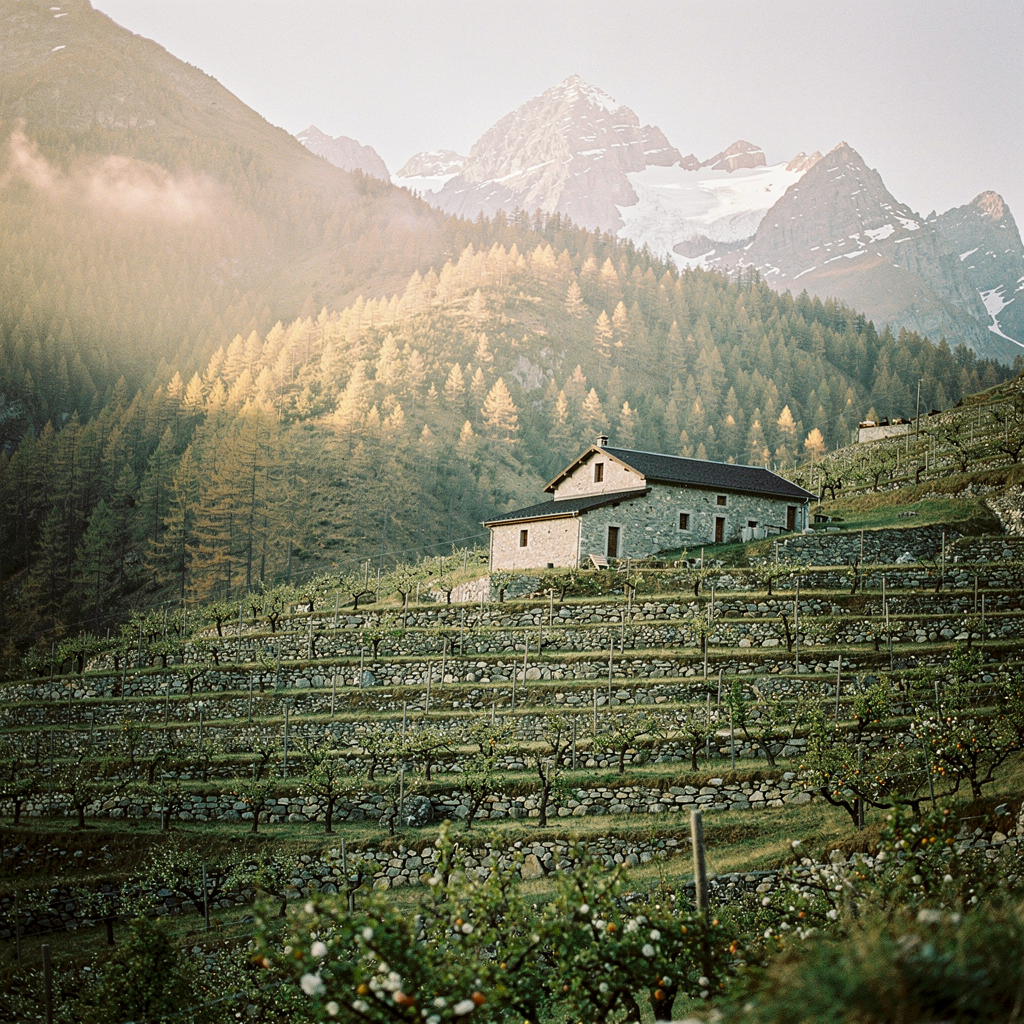
Valais is the reason Solstice Gin exists. Its botanicals, its water, its apricots, its larch forests — none of it is replaceable. If we use this region as the foundation of our product, we carry a responsibility to ensure it remains as it is.
This is not sentiment. It is self-interest — and it is the right thing to do.
Regional Raw Materials as First Principle
The most direct contribution to sustainability is what we buy and where we buy it. Our apricots from orchardists in central Valais. The spring water from the high mountains. Larch wood from local foresters.
Short supply chains mean less transport, less packaging, fewer intermediaries. They also mean that the money we spend on raw materials stays in the region. That is economic circulation, not just ecology.
Wildcrafting with Rules
We gather part of our botanicals ourselves. This gives us maximum control over quality and provenance — but it also means responsibility. We never take more than a third of the visible crop at any site. We rotate between sites so no plant population is overused. We report unusual botanical finds to the cantonal nature protection authority.
These rules are not imposed on us. They are the only way to still be foraging here in ten years.
Energy Consumption: What a Distillation Costs
A distillation uses energy. That is a physical fact that cannot be argued away. What can be shaped is efficiency.
We distil once per batch — which means less energy consumption than multiple distillations. The cooling water that cools the condenser is not discarded but used for cleaning the equipment. The waste heat from the still heats the room. Small measures that add up to something.
We will not claim to be carbon neutral. We will also not make the mistake of pretending small gestures are enough. What we can say: with every batch we think about where effort doubles unnecessarily.
Packaging
A glass bottle is the heaviest component in shipping a bottle of gin. We chose a heavy, high-quality bottle — not out of ignorance of the weight, but because a bottle you pick up doesn't inspire a single-use thought. It should stand for a long time, be refilled or repurposed. A shipping carton of recycled corrugated cardboard, no polystyrene.
This is not a perfect system. But it is one that can be defended.
The Honest Reckoning
A distillery will never be a fully sustainable business. Alcohol needs energy. Glass needs energy. Transport needs energy. Anyone who claims otherwise is either lying or calculating incorrectly.
What we can offer: a product made with care. That destroys as little as possible of what makes it possible. That leaves the region that sustains it as it found it — or a little better.
That is not a grand gesture. But it is the standard we work to.