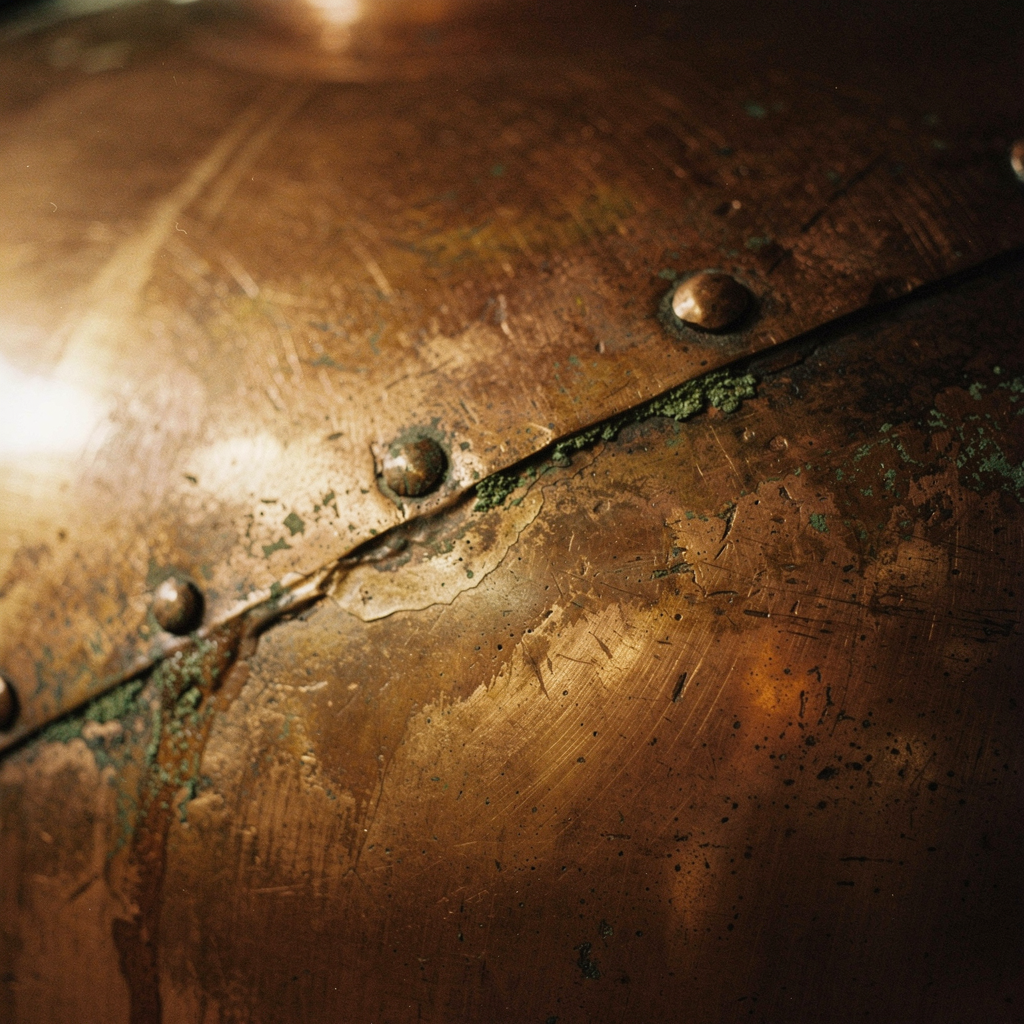
Copper pot stills look good. Warm, gleaming, artisanal. That is one reason many distilleries display them in their shopfronts. But it is the wrong reason to use copper.
The right reason is chemistry.
The Problem with Sulphur
During fermentation and distillation, sulphur compounds form — dimethyl sulphide, hydrogen sulphide, mercaptans. In small quantities they are part of the natural aromatic profile of many distillates. In larger quantities they smell of rotten eggs, rubber or burnt material. No distiller wants that in the heart cut.
How do they form? During fermentation, yeasts produce sulphur compounds as a by-product. How much depends on the yeast strain, temperature and composition of the base spirit. Sulphur compounds always form to some degree.
What Copper Does
Copper reacts with sulphur compounds and binds them. Technically: copper catalyses the oxidation of sulphur compounds into odourless copper sulphates, which deposit on the inner wall of the still rather than passing into the vapour.
This means: the more contact surface between vapour and copper, the less sulphur in the distillate. That is why traditional copper pot stills are built with long, curved necks — not for beauty, but to maximise contact surface. It is why many distilleries have copper spirals or copper packing in their condensers.
Why Stainless Steel Doesn't Replicate the Chemistry
Stainless steel is standard in the food industry — hygienic, robust, economical. In distillation it has a fundamental drawback: it does not react with sulphur compounds. A stainless steel still lets everything through that forms.
This doesn't mean stainless steel distillates are automatically inferior — in modern installations with multiple rectification and filtration, the problem can be worked around. But it is more work for less result. We inherited a copper still. We already knew why we wanted to keep it.
Caring for the Still
Copper oxidises. That is its property, and it is its purpose — but it also means the still must be maintained. After every batch it is cleaned; the copper oxide that forms on the inner wall is regularly removed.
A well-maintained still works better. Its surface is reactive, fresh, hungry for the sulphur compounds it is meant to neutralise. A neglected still with a thick oxide layer works less well. This is one of many reasons why distilling is attention — not a process that runs while you do something else.
What This Means in the Glass
A gin distilled in a copper pot still is cleaner, rounder, more elegant in the mid-palate. The botanicals express themselves without a sulphurous undertone. The texture is softer. The finish clearer.
This is not a promise. It is the reason copper pot stills have been the preferred tool of the world's finest distilleries for centuries — not for their appearance, but for their chemistry.